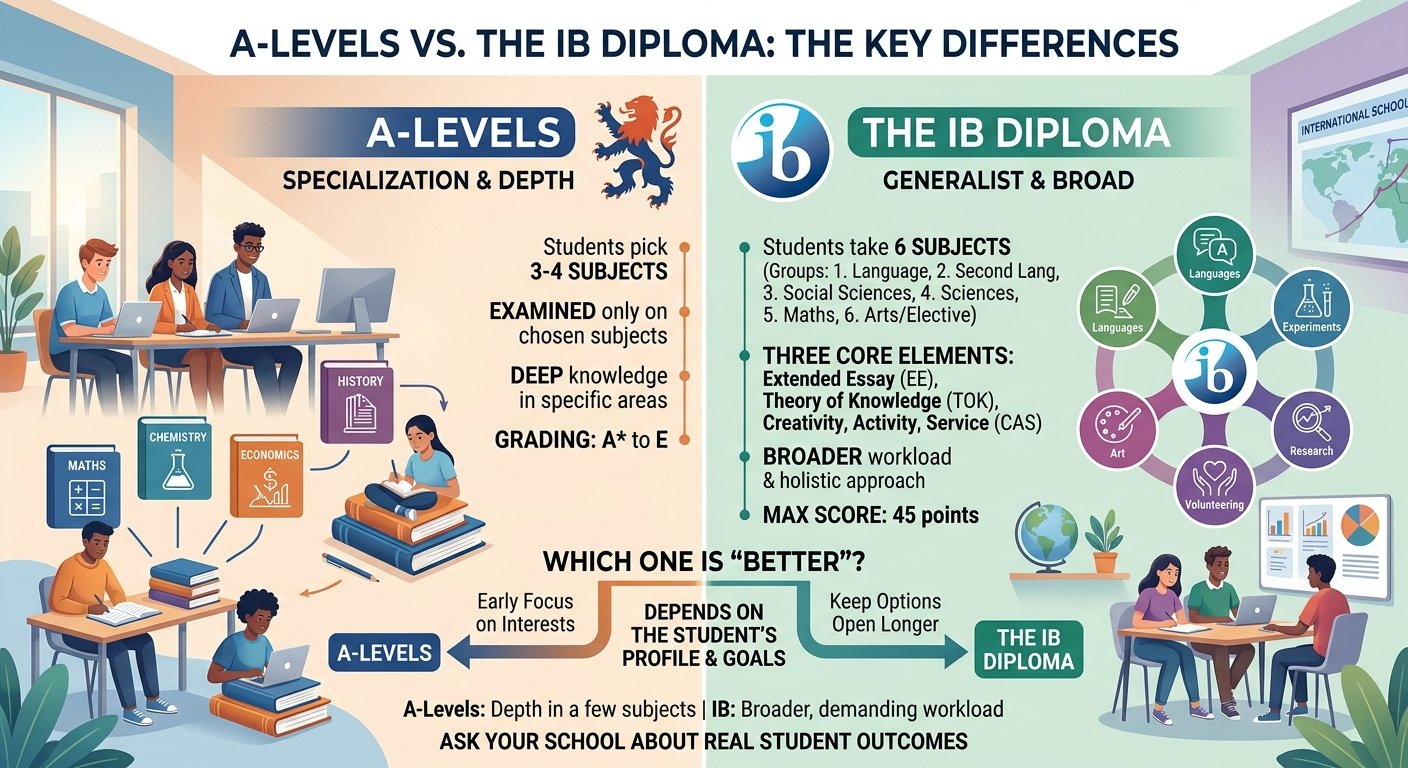
A-Levels vs. the IB Diploma: the key differences
If you're looking at international or British schools in Spain, you'll likely come across these two options for the last two years before university (ages 16-18): A-Levels and the IB (International Baccalaureate) Diploma Programme. Both are recognized by universities worldwide, but they're structured quite differently.
A-Levels work through specialization: students typically pick 3 to 4 subjects (from a wide range, anything from Maths to Art) and are examined only on those, in depth. Each subject is graded A* to E. It's a model that rewards focusing early on what a student is good at or interested in, but it also closes doors sooner — drop Biology, and you're not picking it back up that year.
The IB Diploma Programme works the other way around: it's more generalist. Students take six subjects at once, spread across required groups (first language, second language, social sciences, sciences, maths, and an elective in the arts or another subject), plus three core elements: the Extended Essay (a small research project), Theory of Knowledge (TOK), and CAS (creativity, activity and service). The maximum score is 45 points.
Which one is "better"? Neither, in the abstract — it depends on the student's profile and which universities and countries they're aiming for. The IB is often valued for its broader, more demanding workload; A-Levels, for allowing real depth in a few subjects. If your child already knows what they want to study, A-Levels can be a better fit; if you'd rather keep options open longer, the IB tends to be the more flexible choice. Either way, ask the school directly what real outcomes their students have had with each program.