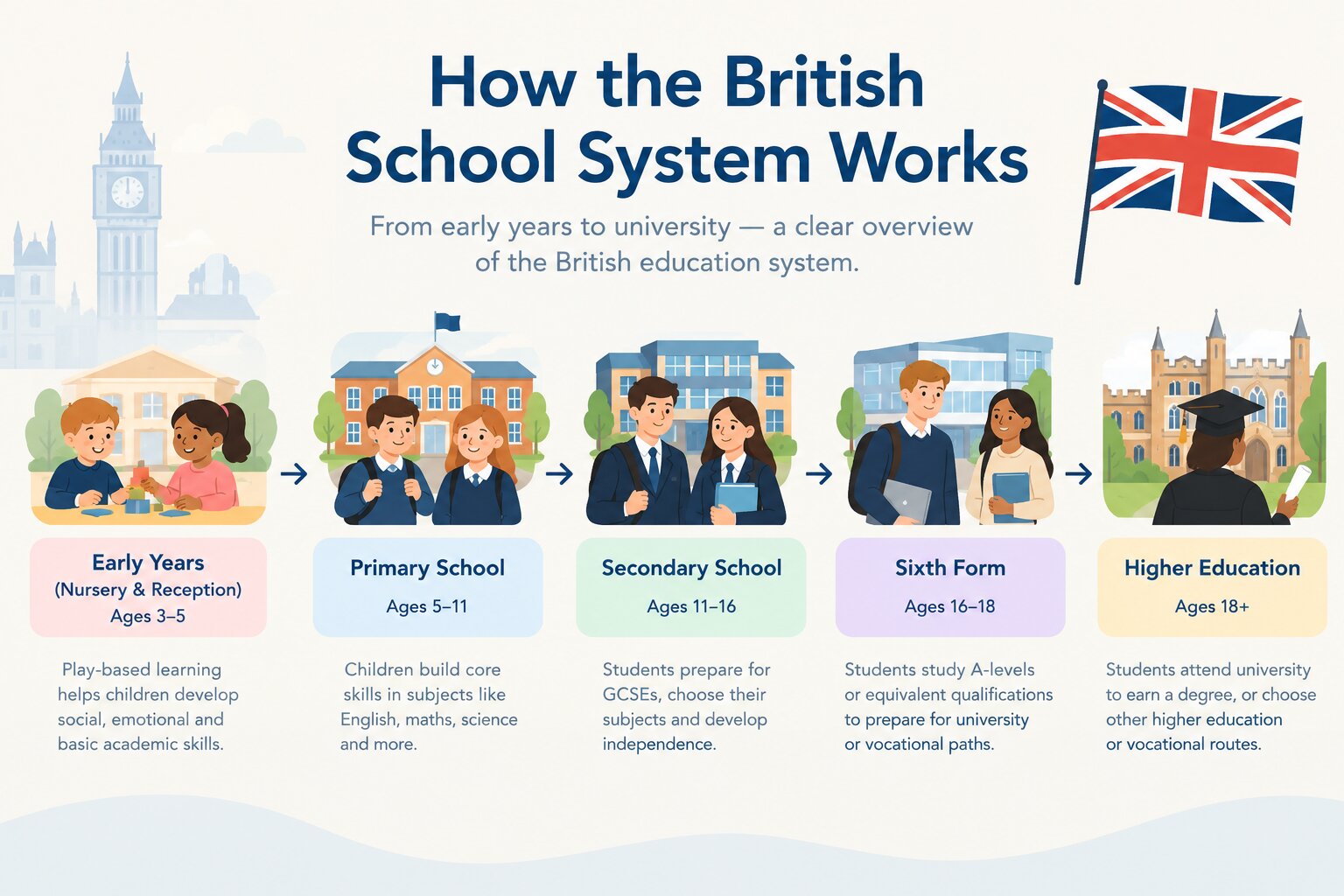
How the British school system works
British schools in Spain (often called "British schools" or advertising a "British curriculum") follow, with some local adaptation, the structure of the UK education system, organized into "Key Stages" rather than the year-by-year system used in Spanish schools.
Broadly: Key Stage 1 and 2 cover Primary Education (ages 5-11, roughly equivalent to late Infantil and Primaria). Key Stage 3 (ages 11-14) is the start of Secondary Education. Key Stage 4 (ages 14-16) ends with GCSE exams (General Certificate of Secondary Education), which students take in several subjects at once and which mark the end of British-style compulsory schooling. After that, Key Stage 5 or Sixth Form (ages 16-18) covers A-Levels, geared toward university entry.
One practical difference from the Spanish system: in the British model, students start choosing subjects earlier and more progressively (first for GCSEs, then even more narrowly for A-Levels), rather than following a shared curriculum until 16-18. This gives room to specialize, but it's worth understanding each school's subject-choice process, since it varies.
If you're considering moving your child from a Spanish school to a British one (or the other way around) partway through, ask specifically how year-group equivalence is handled — it doesn't always match up neatly by age, and schools typically use their own judgment to decide which Key Stage or Year Group fits a given student best.