Public vs Concertado vs Private Schools in Spain: What's the Difference?
Choosing a school for your child in Spain can feel overwhelming, especially if you're new to the Spanish education system.
One of the first things parents discover is that there are three main types of schools: public schools (colegios públicos), concertado schools (colegios concertados), and private schools (colegios privados).
But what exactly is the difference between them? How much do they cost? And which option might be right for your family?
In this guide, we'll explain the key differences between public, concertado and private schools in Spain.
The three types of schools in Spain
Spain has three main categories of schools:
- Public schools (Colegios Públicos)
- Concertado schools (Colegios Concertados)
- Private schools (Colegios Privados)
The biggest differences relate to funding, costs, admissions, curriculum and how the schools are managed.
1. Public schools in Spain (Colegios Públicos)
Public schools are funded and managed by the government.
Education at public schools is generally free of tuition fees, making them the most affordable option for families.
Most public schools follow the Spanish national or regional curriculum, and the main language of instruction is usually Spanish or, depending on the autonomous community, a regional language may also play an important role.
For example, in different parts of Spain, children may also be taught in:
- Catalan
- Valencian
- Basque
- Galician
Advantages of public schools
Public schools can offer several advantages:
- No tuition fees
- Children are part of the local community
- A good opportunity to learn Spanish
- Children can develop friendships with local families
- Schools generally follow the official Spanish education system
For families planning to stay in Spain long-term, a public school can be a great way for children to integrate into Spanish life and culture.
Things to consider
The quality and atmosphere of public schools can vary significantly depending on the area.
Class sizes, facilities, language policies and extracurricular activities may differ from one school to another.
Admission is also often based on factors such as:
- Where you live
- Family circumstances
- Siblings already attending the school
Because of this, families may not always have complete freedom to choose any public school they prefer.
2. Concertado schools in Spain (Colegios Concertados)
Concertado schools are one of the most distinctive parts of the Spanish education system.
They are privately managed schools that receive public funding.
This creates a system somewhere between a public and a fully private school.
Concertado schools are privately operated, but they receive government funding for certain stages of education and must follow specific rules and regulations.
Are concertado schools free?
This is one of the most common questions parents ask.
The answer is: it depends.
The compulsory education covered by public funding should generally not involve tuition fees. However, many concertado schools may charge families for additional services or activities.
These can include:
- School meals
- After-school activities
- Extended school hours
- Educational materials
- Technology programmes
- Extracurricular activities
- Other complementary services
It is therefore important to ask each school for a clear explanation of all potential costs.
What are concertado schools like?
Concertado schools can vary considerably.
Some are relatively traditional, while others offer modern teaching methods, bilingual programmes or specialised educational approaches.
Many concertado schools have a strong local reputation and are popular with families in their area.
Some may also have a particular educational or religious identity. Historically, many concertado schools in Spain have been linked to religious organisations, although this is not the case for every concertado school.
Advantages of concertado schools
Potential advantages include:
- Lower costs than fully private schools
- Privately managed schools
- Structured educational environments
- Often strong community connections
- Some schools offer bilingual programmes
- A wide variety of educational approaches
Things to consider
Admission can be competitive, particularly at popular schools.
Concertado schools may also have admission criteria and processes influenced by regional education authorities.
It's important to remember that not all concertado schools are the same. Their teaching style, facilities, language programmes and overall atmosphere can differ significantly.
This is why visiting the school and speaking to other parents can be particularly valuable.
3. Private schools in Spain (Colegios Privados)
Private schools are independently funded and managed.
Unlike public and concertado schools, they generally do not receive public funding for their core educational provision.
As a result, families usually pay tuition fees.
Private schools can vary enormously in terms of price, curriculum and educational philosophy. They include:
- Spanish private schools
- International schools
- British schools
- American schools
- French schools
- German schools
- International Baccalaureate (IB) schools
International private schools
Many international schools in Spain are private schools.
These schools may follow an international curriculum rather than the standard Spanish curriculum. Examples include:
- The British curriculum
- The International Baccalaureate (IB)
- The American curriculum
- Other national education systems
International schools can be particularly attractive to expatriate families or families who move frequently between countries.
Advantages of private schools
Private schools may offer:
- Smaller class sizes
- International curricula
- Bilingual or multilingual education
- Extensive facilities
- A wide range of extracurricular activities
- Greater flexibility in their educational approach
However, these benefits depend heavily on the individual school.
A higher price does not automatically mean that a school is the best fit for every child.
Things to consider
The biggest consideration is usually cost.
Private school tuition fees in Spain can vary dramatically depending on:
- Location
- Curriculum
- Facilities
- Age of the child
- Reputation of the school
Additional costs may also apply for:
- Registration
- School transport
- Meals
- Uniforms
- Books
- Technology
- Extracurricular activities
Before enrolling your child, it's always worth asking for a complete overview of all costs.
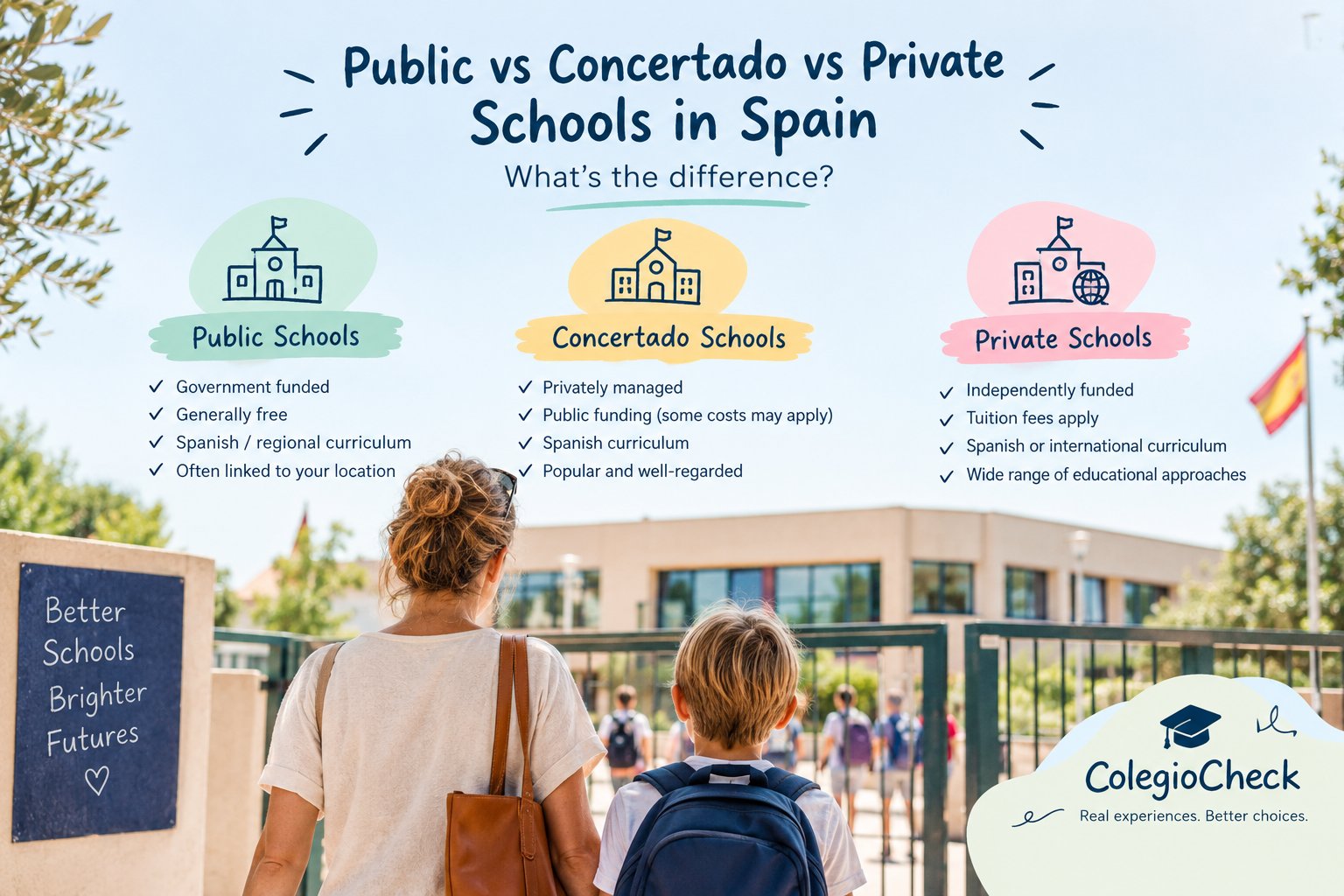
Public vs Concertado vs Private Schools: A Quick Comparison
| Public | Concertado | Private | |
|---|---|---|---|
| Funding | Government-funded | Publicly funded and privately managed | Privately funded |
| Tuition fees | Generally free | Core education is publicly funded, but additional costs may apply | Families pay tuition fees |
| Management | Government | Private organisation | Private organisation |
| Curriculum | Usually Spanish/regional curriculum | Usually follows Spanish education requirements | Can follow Spanish or international curricula |
| Languages | Spanish and/or regional languages | Often Spanish and regional languages, sometimes bilingual | Spanish, bilingual or international |
| International programmes | Less common | Available at some schools | Common, particularly at international schools |
| Admissions | Often linked to location and official criteria | Subject to regulations and admission criteria | Depends on the individual school |
Which type of school is best?
There is no single answer.
The best school for your child depends on many factors, including:
- Your child's personality and needs
- Your family's budget
- How long you plan to live in Spain
- The language your child speaks
- Your preferred curriculum
- Your child's future education plans
- The schools available in your area
For example, a family planning to settle permanently in Spain may prioritise Spanish language immersion and integration into the local community.
Another family may prefer an international school because they expect to move to another country in the future.
For some families, a concertado school may offer an attractive balance between affordability and a particular educational environment.
Questions to ask before choosing a school
Regardless of whether you're considering a public, concertado or private school, it's worth asking:
1. What curriculum does the school follow?
Understanding the curriculum is particularly important if your child may eventually move to another country or apply to university abroad.
2. What languages are used in the classroom?
Don't assume that a bilingual school means that every subject is taught equally in two languages.
Ask how much teaching takes place in each language.
3. What are the total costs?
Ask for a complete breakdown of costs, including:
- Tuition
- Registration fees
- Meals
- Transport
- Books
- Technology
- Uniforms
- Extracurricular activities
4. What are the class sizes?
Class size can affect the learning environment and the amount of individual attention children receive.
5. What support is available for children who don't speak Spanish?
This is particularly important for international families moving to Spain.
Ask whether the school provides language support for new students.
6. What do other parents think?
A school website can tell you a lot about a school's facilities and educational philosophy.
However, parents' experiences can provide a different perspective.
Reading reviews and speaking to families with children at the school can help you better understand the day-to-day experience.
Don't choose a school based on reputation alone
A school may have an excellent reputation, but that doesn't necessarily mean it's the right school for your child.
Every child is different.
Some children thrive in highly structured environments, while others may do better in smaller, more flexible or creative schools.
When possible, visit the school.
Pay attention to:
- The atmosphere
- How teachers interact with students
- The facilities
- The communication with parents
- How happy and engaged the children appear
And don't be afraid to ask questions.
Find and compare schools in Spain
Choosing a school is an important decision, and there is rarely a perfect answer.
The best approach is to research your options, visit schools and gather different perspectives.
At ColegioCheck, parents can discover information and experiences about private, concertado and international schools in Spain.
Reading reviews from other parents can help you understand what a school is really like beyond brochures and marketing materials.
And if you already have experience with a school, sharing your own review can help another family make an informed decision.
Explore schools, read parent experiences and share your own experience on ColegioCheck.
Frequently asked questions
What is a colegio concertado in Spain?
A colegio concertado is a privately managed school that receives public funding. It operates within the Spanish education system and must follow certain government regulations.
Are concertado schools private?
Concertado schools are privately managed but receive public funding. They are therefore different from both fully public and fully private schools.
Are public schools in Spain free?
Public education is generally free of tuition fees. However, families may still have additional expenses for items such as school meals, books, materials or extracurricular activities.
Do private schools in Spain follow the Spanish curriculum?
Some do, while others follow international curricula such as the British curriculum, the International Baccalaureate (IB), the American curriculum or other national education systems.
Are concertado schools cheaper than private schools?
In general, concertado schools are often less expensive than fully private schools because they receive public funding. However, additional charges may apply depending on the school.
Can foreign children attend public schools in Spain?
Yes, foreign children can attend schools in Spain, subject to the relevant admission procedures and residency requirements. The exact process may vary depending on the autonomous community and individual circumstances.
How do I choose the best school for my child in Spain?
Consider factors such as curriculum, language, location, costs, educational philosophy, class sizes and your child's individual needs. Visiting schools and reading experiences from other parents can also help you make a more informed decision.